
How many of your patients would recommend your hospital to someone they love?
Not how many walked in. Not how many followed you on Instagram. Not how many saw your ad.
How many would put their reputation on the line and say –
“Go here. I trust them with my family.”
If you don’t know that number, you’re not measuring growth. You’re measuring noise.
The Metric Most Hospitals Ignore
There’s one metric that answers this question with brutal clarity:
Net Promoter Score (NPS).
One question. One scale. One truth.
“On a scale of 0-10, how likely are you to recommend this hospital?”
Simple. But in healthcare, this number decides everything – your reputation, your referral pipeline, your long-term growth, and ultimately, your survival in an increasingly competitive market.
Here’s the problem: most hospitals don’t track it. And the ones that do? They track it wrong.
Why NPS Matters More in Healthcare Than Any Other Industry
Healthcare is fundamentally different from every other industry when it comes to how customers (patients) make decisions. Here’s why NPS carries disproportionate weight:
1. Word of Mouth Isn’t a Channel – It IS the Channel
A patient doesn’t Google “best eye hospital” and click the first ad. They call their brother. They ask their neighbour. They trust the person – not the campaign.
In healthcare, the referral doesn’t come from a landing page. It comes from a conversation at a family dinner, a WhatsApp message, or a casual mention at the office. Every single one of those conversations is powered by one thing: how the patient felt after their experience.
No ad budget can replicate that. No SEO strategy can outrank a trusted family member’s recommendation.
Word of mouth in healthcare isn’t just a channel. For most hospitals, especially in markets like Kerala, it is the dominant channel – responsible for 60–80% of new patient acquisition in many case
2. The Multiplier Effect of One Unhappy Patient
One unhappy patient in Kerala doesn’t just leave quietly. They take their family, their WhatsApp group, and three generations of trust with them.
One bad experience doesn’t cost you one patient. It costs you fifty.
Think about the social dynamics of healthcare decisions in India. A family typically has one “health advisor” – the person everyone calls when someone needs a doctor. If that person has a negative experience at your hospital, you don’t just lose them. You lose every person who would have come on their recommendation.
And in the age of WhatsApp groups and Google Reviews, the blast radius of a single negative experience has expanded exponentially. One detailed negative review can influence hundreds of potential patients before your marketing team even knows it exists.
3. High NPS = Lower Marketing Spend
A hospital with high NPS spends less on advertising. Why? Because their patients are running the most powerful campaign money can’t buy – a personal recommendation.
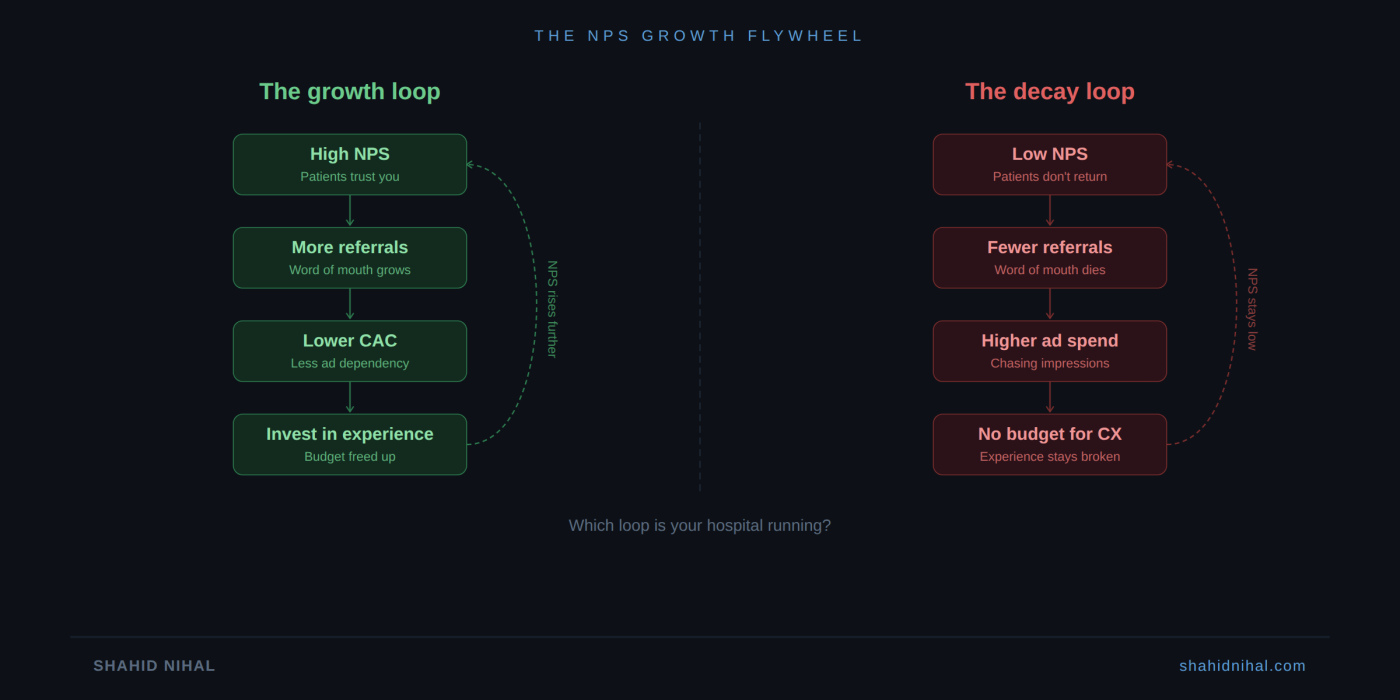
This is the flywheel effect that most hospital administrators fail to understand:
- High NPS → More referrals → Lower cost per acquisition → More budget for experience improvement → Even higher NPS
- Low NPS → Fewer referrals → Higher ad dependency → Budget squeezed → Experience stays the same → NPS stays low
The hospitals that will dominate the next decade aren’t the ones with the biggest marketing budgets. They’re the ones whose patients can’t stop talking about them.
3. High NPS = Lower Marketing Spend
A hospital with high NPS spends less on advertising. Why? Because their patients are running the most powerful campaign money can’t buy – a personal recommendation.
This is the flywheel effect that most hospital administrators fail to understand:
- High NPS → More referrals → Lower cost per acquisition → More budget for experience improvement → Even higher NPS
- Low NPS → Fewer referrals → Higher ad dependency → Budget squeezed → Experience stays the same → NPS stays low
The hospitals that will dominate the next decade aren’t the ones with the biggest marketing budgets. They’re the ones whose patients can’t stop talking about them.
"One bad experience doesn't cost you one patient. It costs you fifty."
How NPS Should Actually Drive Your Marketing Strategy
Here’s the framework that changes everything. Instead of treating NPS as a feedback score, treat it as a strategic decision filter:
NPS Below 50? Stop Increasing Ad Spend.
You don’t have a visibility problem. You have a trust problem. Fix the experience first.
Pouring more money into ads when your NPS is below 50 is like turning up the volume on a broken speaker. You’ll reach more people, but what they hear from existing patients will cancel out every rupee you spend.
Before you touch your ad budget, answer these questions:
- Where are patients dropping off in their experience journey?
- What are the top 3 complaints in your Google Reviews?
- Which department has the lowest satisfaction scores?
- What’s the average wait time, and how does it correlate with NPS?
Fix these first. Then scale.
Where Most Hospitals Go Wrong with NPS
Even among the hospitals that do track NPS, the execution is almost always broken. Here’s the pattern I see repeatedly:
They collect NPS scores. They put it in a PDF. They file it. Nobody in marketing ever opens it.
That’s not a metric. That’s a graveyard.
NPS should be the single biggest input to your marketing strategy – not a customer experience afterthought buried in an operations report.
The disconnect usually happens because NPS lives in the “quality” or “operations” department, while marketing operates in a completely separate silo. Marketing is optimising ad spend, tracking impressions, and measuring follower counts – while the most important indicator of growth potential sits untouched in someone else’s folder.
NPS Above 70? Stop Chasing Impressions.
Invest in referral programs, patient advocacy, and community camps. Your patients WANT to talk about you. Give them a reason and a platform.
When your NPS is above 70, your marketing strategy should shift fundamentally:
- Launch a structured referral program with meaningful incentives
- Create shareable patient experience content (video testimonials, success stories)
- Invest in community health camps that give satisfied patients a reason to bring their network
- Build a patient advocacy program where promoters become informal brand ambassadors
At this stage, every rupee spent on enabling word-of-mouth will outperform every rupee spent on paid media. The math is unambiguous.
Three Things Every Hospital Should Do with NPS Starting This Month
1. Segment by Department
Your overall hospital NPS is a vanity number. What matters is the departmental breakdown.
Your cataract unit might score 85. Your retina unit might score 35. Same hospital. Completely different experience. The average hides the problem.
When you segment NPS by department, you suddenly see where your reputation is being built – and where it’s being destroyed. This is actionable intelligence that no amount of Google Analytics data can give you.
Go further: segment by doctor, by shift, by day of the week. The patterns will surprise you.
2. Track Monthly, Not Annually
An annual NPS is a post-mortem. A monthly NPS is a pulse check.
By the time your yearly score drops, you’ve already lost hundreds of families. Monthly tracking lets you catch problems in weeks, not years. It turns NPS from a rear-view mirror into a windshield.
Set up a simple system:
- Send NPS surveys via SMS or WhatsApp 48 hours post-discharge
- Dashboard the results by department, weekly and monthly
- Set threshold alerts (any department dropping below 50 triggers an immediate review)
- Share the dashboard with both operations AND marketing teams
3. Call Every Detractor Back
Every patient who scores 0–6 is handing you a gift – they’re telling you exactly what’s broken.
Call them. Fix it. Turn them into promoters.
That single action has a higher ROI than any ad campaign you’ll ever run. Here’s why:
- A detractor who gets a personal callback often becomes your strongest advocate
- The feedback you receive is specific, actionable, and free
- It demonstrates a level of care that patients don’t expect – and that becomes its own word-of-mouth story
I’ve seen hospitals turn detractors into promoters with a single 5-minute phone call. The patient didn’t expect anyone to care. When someone did, the entire narrative changed.
NPS as a Strategic Decision – Not a Marketing One
Here’s the final shift in thinking that matters most:
NPS doesn’t tell you how much to spend. It tells you WHERE to spend.
And that’s a strategic decision – not a marketing one.
When NPS drives your strategy:
- Budget allocation becomes evidence-based, not gut-based
- Department heads become accountable for patient experience, not just clinical outcomes
- Marketing and operations stop working in silos
- Growth becomes predictable, not accidental
The hospitals that will win the next decade aren’t the ones with the biggest budgets. They’re the ones whose patients can’t stop talking about them.
Start Here
If you’re running a hospital and, reading this, here’s your Monday morning action item:
Find out your NPS. Not your hospital’s overall score – your NPS by department, this month.
If that number doesn’t exist yet, that’s your first problem to solve. Everything else – your ad strategy, your content calendar, your brand positioning – is secondary.
If you’re not measuring it, you’re not measuring growth.
